Firsthand coverage of the London premiere, the documentary’s 20 contributors, verified sporting achievements and its scheduled public release.
UNSEEN: The Athletes of Northern Cyprus premiered at The Soho Hotel in London on Sunday, 1 November 2026. The documentary explores the achievements and opportunities of Turkish Cypriot athletes, alongside the institutional challenges affecting international sporting participation. Its public release is scheduled for Monday, 9 November 2026 on the official Freedom and Fairness for Northern Cyprus YouTube channel.
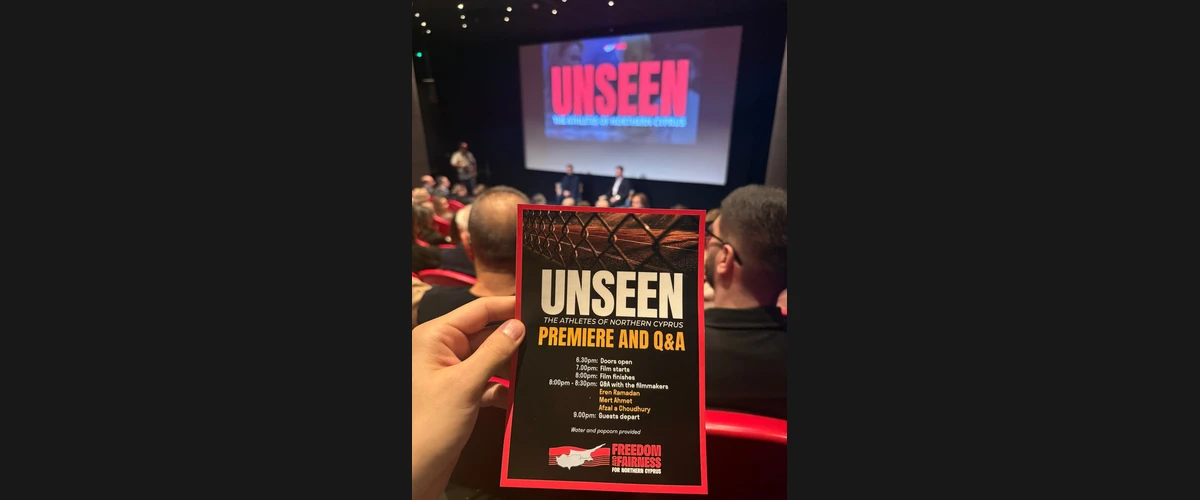
NorthCyprus-Guide.com attended the premiere by invitation. Our founder watched the screening and the post-film programme, taking the original photographs accompanying this feature. That firsthand attendance informs our account of the evening; the sporting biographies and institutional explanations below draw on separately linked records, university publications and reporting.
The published contributor list names 20 people: competitors, former athletes, coaches, administrators, a wheelchair-basketball mechanic and digital storytellers. Their experiences are not interchangeable. Some have reached Olympic finals or championship-winning professional squads; others organise domestic competition or help make local sporting life visible. The film brings those different roles into one conversation.
Published 1 November 2026. By North Cyprus Guide Editorial. Release information reflects the announced schedule at publication; the full film is not yet scheduled to be publicly available.
The Soho Hotel hosted the invited screening on 1 November. The printed programme, photographed inside the cinema, scheduled the film between 7 pm and 8 pm, followed by a filmmakers’ Q&A from 8 pm to 8.30 pm. It named Eren Ramadan, Mert Ahmet and Afzal Choudhury as the discussion participants. These are the programme’s timings, not a separately measured running time or a claim that every item began precisely on schedule.

The premiere offered a chance to see UNSEEN before its announced YouTube release. Our photographs document the programme, the venue and the post-screening discussion. We have not attached names to the people seated in the Q&A photograph because their positions have not been independently confirmed. Nor do we report private conversations, invent quotations or infer the audience’s reaction from the images.
The documentary’s published announcement and contributor list identify a filmmaking team led by Mert Ahmet, Afzal Choudhury and Eren Ramadan, supported by Freedom and Fairness for Northern Cyprus. That support is important editorial context: the organisation advocates for changes to Northern Cyprus’s international connections, while this article distinguishes its arguments from verified sporting results and governing-body rules.
UNSEEN examines the relationship between sporting achievement and access to competition. Its range extends from athletics, basketball and boxing to tennis, volleyball, open-water swimming and drifting. Wheelchair basketball receives a broader treatment through players, coaching, federation leadership and technical support, rather than being reduced to a single athlete’s story.
International participation is one thread, but recognition of a sporting federation is different from an individual’s eligibility. A local organisation may lack a route into a world federation’s national-team competitions while an athlete competes through Türkiye, a professional club or another recognised structure. The film’s contributors illustrate several such pathways. It would be inaccurate to describe Turkish Cypriot athletes as universally prohibited from international sport.
Youth development raises another set of questions: which competitions allow emerging athletes to test themselves, how coaching is sustained, and where training can lead. Women’s sporting histories help place newer careers in a longer tradition. Motorsport adds a discipline with its own licensing and event structures. The photographers and creators broaden the focus again, showing that recording sport and reaching audiences are part of its wider ecosystem, even when the person holding the camera is not competing.
Buse Savaşkan provides a clear example of Turkish Cypriot achievement within an internationally recognised national team. Born on 24 February 1999, she competed for Türkiye at Paris 2024 and reached the women’s high-jump final. The official World Athletics results record tenth place with 1.86 metres on 4 August 2024. She was an Olympic finalist, not an Olympic medallist.
Her World Athletics profile lists a personal best of 1.93 metres, achieved on 24 June 2025. The Diamond League profile identifies the meeting in Brno and also records fourth place in Marrakech in May 2024. These dated records show progress beyond the Olympic season. Her participation demonstrates a route into elite athletics through Türkiye; it does not by itself establish the citizenship, selection or administrative history behind every stage of that route.
Ada Kafa is a middle-distance runner born on 3 April 2009. Her World Athletics record lists an outdoor 800-metre best of 2:08.41 in İzmir on 17 June 2026, alongside a short-track 800-metre best of 2:10.86. Eastern Mediterranean University’s June report identifies her as an EMU athlete, reports her Türkiye U18 title and explains that the İzmir time surpassed the world U20 qualifying standard it cited.
An important qualification is necessary. UNSEEN publicity describes Kafa as a European U18 800-metre champion. We could not establish the exact European Athletics championship, year and final result supporting that description. EMU reports also use inconsistent wording about that title and a subsequent European target. We therefore do not present a continental championship gold as independently verified. Her documented times and national title still provide substantial evidence of a promising young career, without inflating a meeting victory into a European championship.
Erten Gazi, born on 15 June 1997, is a guard whose career includes four EuroLeague seasons with Anadolu Efes. His official EuroLeague profile records appearances in 2020–21, 2021–22, 2022–23 and 2023–24. The first two were Efes’s successive championship seasons, giving the documentary’s two-time champion description its context: he belonged to those title-winning teams, rather than receiving two individual championship awards.
His development also included school basketball. Anadolu Efes’s own reporting records Doğa Koleji winning the Turkish schools championship in March 2015 and the World Schools Championship in Limoges the following month. Gazi scored in both reported finals. These records give a concrete progression from school competition to an elite professional environment. The archived EuroLeague team label should not be treated as proof of his current club, and we do not add unverified national-team caps.
Sugar Atahasan is billed by UNSEEN as a professional boxer and founder of Sugar Boxing Academy. The British and Irish Boxing Authority record lists three wins, one loss and no draws in its published bout history. It records an August 2024 victory over Lovepreet in Aberdeen for the vacant Professional Boxing Council Silver International title, with the contest stopped in round four of a scheduled eight.
That is a specifically named title, not a claim to one of professional boxing’s major world championships. The same record lists wins over Pablo Narvaez and Marty Kayes, and a loss to Jack Jones. T-VINE’s report of the Kayes bout adds a unanimous 40–36 decision. Licensing bodies’ records can differ, so the BIBA total is identified as that body’s published record rather than a guaranteed universal tally. His academy role adds training and development to the film’s account of professional competition.
Doğukan Ulaç’s open-water career includes repeated success in the Bosphorus Cross-Continental Swimming Race. Specialist coverage of the 2025 event records men’s victories in 2018, 2022, 2023 and 2025. His 2025 winning time was 56:49 over the 6.5-kilometre Kanlıca–Kuruçeşme route.
For the 2026 edition, Anadolu Agency reports that Ulaç finished second in 52:03 behind Selim Oğuz. These times should not be compared like standardised pool records: currents, conditions and the route influence an open-water race. His repeated podium-level performances are the stronger measure of sustained competitiveness. Open-water swimming involves navigation, pacing and adaptation as well as fitness, making it a useful counterpoint to the controlled settings of track or indoor court sport.
Dr Ayten Salih Berkalp connects the documentary to an earlier generation of women’s sport. A University of Kyrenia biography describes her involvement in establishing Fenerbahçe women’s teams in the 1950s, including volleyball in 1954, and captaincy across volleyball, basketball, athletics and rowing. She graduated from Istanbul’s Faculty of Medicine in 1960, later combining a medical career with public service in Cyprus.
The institution also records her participation in representative volleyball and discusses her contribution to a volleyball encyclopedia. Such a career matters beyond a single score or medal: building teams, sustaining participation and preserving sporting history are achievements of a different kind. Accounts disagree on her birth year, so we omit it rather than choose between them. Nor do we convert broad descriptions of pioneering status into an unaudited list of “firsts”. UNSEEN identifies her specifically as a founding figure in Fenerbahçe women’s sport, not as founder of the club itself.
UNSEEN identifies Ayten Gazi as a former athletics competitor. Local retrospective reporting also describes her school basketball and athletics background in Güzelyurt. A reported BRT sports interview identifies her as Erten Gazi’s mother and discusses support for his educational and sporting pathway. These sources establish a sporting and family-development connection; they do not establish an individual athletics medal tally, event record or personal best. Her inclusion places women’s participation and the work of sporting families alongside more readily tabulated professional results.
Azra Yalkıç is listed as a tennis player and coach. Girne American University’s report records success in an under-16 girls’ federation competition while she represented The American College. Later GAU-linked reporting records victory at a Turkish Tennis Federation adult weekend tournament in Sakarya, held between 2 and 5 June 2022. That is a particular tournament win, not a Turkish national championship. The production’s coaching credit connects her playing experience with player development, although a coaching licence, employer and subsequent coaching results were not independently established.
Uğur Gazi is a former professional volleyball player in UNSEEN’s contributor list. Havadis reporting on another player’s Galatasaray pathway identifies him as an earlier Turkish Cypriot player to wear the club’s colours. The family sports interview identifies him as Erten Gazi’s father. This provides a documented professional-club connection and an intergenerational sporting link, without inventing seasons, trophies or national-team appearances. His role complements Ayten Gazi’s: the film includes people whose own sporting lives also form part of a younger athlete’s support network.
Wheelchair basketball is competitive basketball, not simply a participation activity. The International Wheelchair Basketball Federation’s rules describe five players per side, four ten-minute periods and the same court and basket dimensions as standing basketball. Players may make two wheelchair pushes while holding the ball before dribbling, passing or shooting. Classification considers functional ability in basketball rather than talent; the IWBF classification explanation sets out how balanced teams are assembled.
Specialist chairs are designed for turning, speed, stability and contact. The International Paralympic Committee’s sport overview explains the sport and its equipment. Reliable wheels, castors, seating and fitting are part of competitive preparation. UNSEEN’s decision to include a mechanic alongside a captain, coach and federation president helps make this less visible infrastructure part of the sporting story.
Ahmet Akdeniz is identified as president of the local Disabled Sports Federation. Contemporaneous reporting of his 2021 appointment describes him as a long-serving wheelchair-basketball player and former captain. That background connects administration with practical sporting experience. In April 2026 reporting on Vakıflar, he discusses the team’s development and its competition programme. Funding, accessible training and organised fixtures are federation concerns, but we do not infer audited budgets or programmes not documented in the sources.
Hasan Serbülent is Vakıflar’s head coach in the film’s published roster. A 2022 match report identifies him in that role when the side beat Antalya Büyükşehir Belediyesi 87–66 in the Turkish wheelchair-basketball Super League. April 2026 reporting instead places the team in First League promotion playoffs. The distinction matters: the earlier Super League season does not establish its current division. His documented involvement spans tactical preparation, player development and the changing demands of a team competing through Turkish league structures.
Murat Ekşi is billed as the team captain. The Antalya match report records 57 points in Vakıflar’s 87–66 victory on 26 March 2022, a concrete individual performance rather than a generic description of leadership. Earlier European competition coverage also reports a group-stage scoring award at the 2015 Challenge Cup. That should not be expanded into a claim to be Europe’s overall leading scorer. His film credit and dated results link captaincy with measurable competitive contribution.
Saadettin Çakas is identified in UNSEEN’s publicity as the Vakıflar wheelchair-basketball team mechanic. No independently documented personal biography or award record was found, so we do not invent a career chronology. His role nevertheless makes an important distinction: technical support is part of sport, not an incidental extra. The IPC’s equipment explanation describes chairs tailored to athletes and sporting demands. This explains why maintenance and equipment reliability matter generally, without pretending to know the specifics of his workshop or methods.
Vakıflar provides direct evidence against a blanket account of exclusion. IWBF Europe’s March 2026 EuroCup 3 results record the team playing in Toulouse, including an 82–54 win over Meylan Grenoble and a 75–65 win over KSS Mustang Konin. The 2026 allocation document lists Vakıflar under club code TUR-16. International club participation through that structure is documented; recognition of a separate Northern Cyprus national team is a different question.
Hasan Gazioğlu is president of the Northern Cyprus Tennis Federation in the contributor list. The federation’s own AGM report confirms re-election in 2025. Contemporaneous coverage describes his ambitions for player development and greater international opportunity. Those aims are not automatically completed achievements. His role concerns the organisation behind domestic competition: clubs, tournaments and player pathways. Access to an overseas tennis event must be considered against that event’s entry and affiliation rules, rather than inferred from a federation president’s title.
Orçun Kamalı became president of the local Turkish Cypriot Olympic committee in March 2025, according to contemporaneous reporting. The title must not imply that he leads an IOC-recognised national delegation. The IOC’s Cyprus entry identifies the Cyprus National Olympic Committee as the recognised body. Kamalı’s organisation and that committee are distinct. His inclusion offers a perspective on coordination among local federations and ambitions for sporting development, not proof of IOC membership or an automatic route to Olympic entry.
Dr Enver Haskasap is presented as a drift driver and Drift NEU founder. Near East University’s staff biography supports his doctoral title through business studies; it should not be interpreted as a medical qualification. Local reporting identifies him as Drift NEU Racing Team director. His profile brings competition, team organisation and the development of a motorsport setting into UNSEEN. We have not repeated a championship claim from reporting whose headline and finishing-position details disagree. Event results and licence arrangements require event-specific evidence.
Juan Black appears in the film’s roster as a drift driver. A reported visit to Drift NEU Racing School identifies Juan Kruis Black as its head instructor and describes his international background through his own account. June 2026 competition coverage records a second-place PRO result. His instruction role adds the transfer of driving skills to the film’s sporting range. Motorsport licences, event permissions and series entry differ from Olympic national-team arrangements; one driver’s competition route should not be treated as a rule for every discipline.
Münür Dağgül is credited as a football content creator and photographer. This production credit establishes his role in UNSEEN, but reliable sources did not establish an employer, accreditation history or complete career chronology. Photography and football content can preserve matches, players and moments that might otherwise receive little coverage. That is the relevance of his contribution to the documentary’s wider subject, rather than a claim that every project attributed to a similarly named social account is his work.
Urban Cypriot is separately listed as a content creator. A Gazedda interview introduction identifies İbrahim Beycanlı as the creator behind the name, and the public channel provides a direct audience destination. Community storytelling can carry local subjects beyond the audience of a sports federation or newspaper. We do not add follower totals, infer a sporting qualification, or attribute views from unseen posts to the documentary participant.
Osman Barışsever is another content creator in the published list, not an alternative name for Urban Cypriot. Independently verified biographical material was limited, so the profile remains correspondingly short. His inclusion shows that the film’s scope extends beyond athletes and office-holders to people producing public-facing content. We do not claim a particular sporting specialism, collaboration, audience size or personal experience without a reliable source.
International representative sport normally depends on recognised sporting organisations as well as an athlete’s ability. A national federation’s membership, a representative team’s entry, an individual’s nationality and a professional club’s registration are different administrative questions. They may overlap, but none should be used as a shorthand for all the others.
The Olympic Charter establishes the recognised national Olympic committee framework. The IOC’s nationality explanation separately addresses competitors. Qualification and selection still matter. A locally named Olympic committee is not automatically an IOC member, and an athlete’s identity does not itself determine which team can enter them.
Football offers a specific institutional example. UEFA’s account of the 2013 arrangement distinguishes the Cyprus Football Association, its FIFA/UEFA member, from the Cyprus Turkish Football Association. The proposed arrangement was a football-specific route, not separate international national-association membership. That announcement does not prove subsequent implementation. FIFA’s statutes also distinguish association membership from player nationality and representative-team eligibility.
Basketball similarly separates national status from professional club participation. FIBA’s federation directory identifies its Cyprus member, while its player regulations set out eligibility and transfer arrangements. Athletics has its own nationality and allegiance rules. Buse Savaşkan’s Olympic results and Vakıflar’s European club results demonstrate actual participation through recognised routes; they do not mean every local federation has equivalent access.
These distinctions matter for development. Fewer suitable competition routes can reduce opportunities to gain experience, attract coaching or plan a career, but the effects must be examined sport by sport. Where UNSEEN or its supporters describe the arrangements as unfairness or isolation, those are their arguments. This article does not turn them into a universal personal ban or assume all 20 contributors encountered the same restrictions.
Turkish Cypriot sport has a longer institutional history than the current generation of competitors. The Cyprus Turkish Football Association’s own history dates its foundation to 1955 and describes the development of separate domestic competitions. The island’s subsequent institutional arrangements left different sporting bodies operating through different pathways. For understanding UNSEEN, that organisational continuity is more useful than reducing every sporting question to one historical event.
Women’s teams, schools, local clubs and later professional pathways have all contributed to that history. Berkalp’s Fenerbahçe career predates the younger contributors’ competitive lives by decades. The Gazi family’s sporting links span more than one generation. Keeping the context centred on institutions, coaching and competition allows readers to understand the documentary without treating it as a comprehensive account of the island’s political history.
The production announcement credits Mert Ahmet as presenter and narrator, with writing, subtitling, translation and contributor liaison. Afzal Choudhury, associated with NoPlaybook, is credited as director and producer, alongside writing, cinematography, editing and colour grading. Eren Ramadan is executive producer and lead researcher, also contributing to writing, communications, logistics and participant coordination. These are the published production credits; we have not reconstructed them from unrelated platform listings.

Freedom and Fairness for Northern Cyprus supported the documentary. Its About page says it advocates direct flights, direct trade and direct contact, campaigning against what it describes as the isolation of Turkish Cypriots. This is the organisation’s stated position, not an independent sporting ruling or a view attributed to every athlete in the film. Its support should be understood alongside the production’s focus and the independently checkable records linked throughout this feature.
The team’s earlier work includes Offside: The Untold Story of Sports in the TRNC, a football-focused documentary discussed on the campaign’s website. UNSEEN broadens that sporting focus. Offside is distinct from the unrelated 2006 film of the same short title. Platform dates and production-credit metadata are not entirely consistent, so we do not use those listings to overwrite UNSEEN’s published credits.
Another related production is DISPLACED: A Turkish Cypriot Story. Our existing documentary guide explains that film and its viewing link. The connection is a filmmaking team and a community-documentary approach, not a reason to treat the three productions as one film or to substitute an earlier documentary’s trailer for UNSEEN.
UNSEEN’s public release is scheduled for Monday, 9 November 2026. Watch UNSEEN on the official YouTube channel. At publication on 1 November, that link leads to the channel, not a verified full-film player. The premiere has taken place, but the announced public-release date is still ahead.
A trailer has been announced, but we could not independently verify a direct UNSEEN video URL, so no trailer player is embedded here. We will retain this article’s address when adding a verified full-documentary link after release. Until then, check the official channel for the release and any changes to the schedule. No price, runtime, subtitle options or geographical availability is promised without confirmation.
For another production from the team, read Displaced, A Turkish Cypriot Story: Documentary Guide. Browse our Culture & Etiquette guides for wider cultural reading. The sporting sources linked above are retained so readers can distinguish records, reported interviews and production publicity.
Editorial verification note: all 20 contributor names and announced roles were checked against the published list. The article flags the unconfirmed European-title description for Ada Kafa and uses shorter profiles where independent biographical evidence is limited. Open-water times are not presented as universal records; club participation is not confused with national recognition. Our original photographs are credited individually, with no generated imagery or contributor-profile placeholders.
A documentary exploring Turkish Cypriot athletes and sporting figures, their achievements, development and the international participation arrangements affecting their sporting lives.
UNSEEN premiered on Sunday, 1 November 2026. NorthCyprus-Guide.com attended by invitation.
The invited premiere took place at The Soho Hotel in London, with a screening and a post-film programme.
The announced public-release date is Monday, 9 November 2026. At this article’s publication on 1 November, that date is still ahead.
The announced destination is the official Freedom and Fairness for Northern Cyprus YouTube channel, linked in the Where to watch section. A direct full-film link has not yet been verified.
Published production credits name Afzal Choudhury as director and producer, Eren Ramadan as executive producer and lead researcher, and Mert Ahmet as presenter and narrator, with additional contributions described in the article.
The 20 contributors are Buse Savaşkan, Ada Kafa, Dr Ayten Berkalp, Sugar Atahasan, Hasan Gazioğlu, Azra Yalkıç, Erten Gazi, Uğur Gazi, Ayten Gazi, Ahmet Akdeniz, Hasan Serbülent, Murat Ekşi, Saadettin Çakas, Doğukan Ulaç, Orçun Kamalı, Dr Enver Haskasap, Juan Black, Urban Cypriot, Münür Dağgül and Osman Barışsever. Not all are current competing athletes.
International representation depends on the relevant sporting body’s nationality, eligibility, qualification and selection rules. Türkiye provides a recognised route for some athletes, including Olympic finalist Buse Savaşkan; this is not automatic eligibility for everyone.
National representative competition may require membership or recognition through international governing bodies. Those institutional arrangements differ from individual eligibility and professional or European club participation, which are documented for some contributors.
Published materials identify earlier work by the filmmaking team including Offside: The Untold Story of Sports in the TRNC. Offside focuses on football, while UNSEEN covers a wider range of sports and supporting roles.